
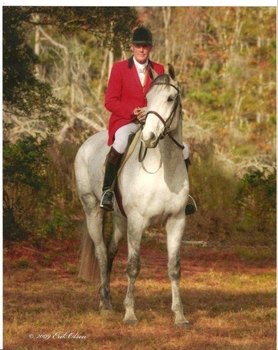
 Paul Striberry on Valentine / Erik Olsen photoA reader who we’ll call Easy-Does-It asks Foxhunting Life for advice on how to get her horse to exit the trailer slowly and safely, as opposed to ejecting itself like an equine cannonball.
We went to Paul Striberry, Lilla Mason, and Robinson Duncan for their expert advice. All agreed that this is a problem that needs fixing, yet each individual took a different approach. While the three recommendations are mechanically different, each is sensible, thoughtful, and promises success. Which all goes to reaffirm that there is more than one way to skin a cat! Or civilize a horse.
Easy-Does-It writes:
My horse’s enthusiasm interferes with his good manners from time to time, but particularly impacts his trailer manners. He loads perfectly, but fast…. I can deal with that. But he unloads like it’s a backward race. It starts with him bouncing back on the bar as soon as I lower the ramp. I have to time a forward bounce to snatch the pin out, which must mean the swinging bar hits him as he comes roaring back, although it’s all going so fast, who knows?
Yesterday his rush caught my hand between him and the trailer wall. It’s bruised but fine, thanks for asking.
I need a good training plan that can slow him down and keep me safe when trailering alone. I can’t use a longe line to hold his head when I am letting him off. He’s too strong.
He trailers calmly (no sweating) and stands quietly in the trailer for the usual hunt breakfast time, with or without a companion.
Paul Striberry
This sounds like an easy problem to solve. Think about spending a Sunday morning just training the horse to load and unload quietly.
Put the horse on the trailer, let him stand there without the butt bar, and then let him back off any way he wants. Keep him on a twelve-inch rope lead but don’t try to restrain him. Keep loading him and backing him off until he does it to your satisfaction. When he gets on and off quietly five or six times, put him away, and then the bring him back in the afternoon.
He has to get on quietly if you expect him to get off in a civilized manner. I am sure if you are patient and persistent you can get the situation under control. Remember that anything your horse does, you have either asked him or allowed him to do, and the horse has to understand what you want before he can do it.
Lilla Mason
When you have a great horse it is easy to overlook some of the bad habits, but good for you for deciding to fix this one before you get hurt. Sounds like your horse is easy to load, good to trailer, but he needs to be more respectful backing out. If you are like me you want to fix this quickly, wasting a minimal amount of fun riding time.
This is the fastest way I can think of that you could do by yourself. First, do some groundwork on safe footing. Use a thin rope halter if you have one, or a regular halter with a chain shank over his nose, and practice making your horse go forward so many steps, backwards so many steps in a straight line. Make sure he is not sluggish about it
and that he obeys your cues.
Then teach him to yield his hindquarters both left and right. Do this by walking towards his flank with an aggressive stance until he moves his hind feet away from you a step or two. Make a game out of it until he gets really responsive. Once he understands what you are asking you can get more and more steps. You may have to swing the end of the lead rope around tapping him gently the first time until he gets the idea.
If this is easy for you both, also teach him to yield his shoulders, stepping his front legs around the back legs. Practice all four things in different succession, just a few steps of each, but one right after another. For example ask him to back four steps, yield the hindquarters left a few steps, yield the hindquarters right a few steps, go forward a few steps, yield the shoulder, on and on. Be gentle but firm. If yielding the shoulder and hind quarters is hard for you then substitute by making small circles around you left then right as you demand.
The idea is to make him keep his feet moving—make him work. Remember, this isn’t punishment; it is just homework, so don’t put emotion into this schooling.
Next load him on the trailer and let him stand there a while with or without the butt bar. Ask him to back out. When he flies out backwards, don’t let him stand still. Start making him go backwards and keep backing him a very long way. Say ten steps for everyone he took on his own. Now start making him do “homework” as you go back towards the trailer. Then load him again.
Let him stand there awhile, thinking, then repeat. I would expect him to fly backwards several times since it is an established habit. Do this until he understands that flying backwards equals homework. Pretty soon he will decide this isn’t working out so well, and he won’t be so anxious to unload. If there is room in your trailer see if you can get him to take one step back and then forward again. Let him stand a while, then ask for maybe two steps back and forward again. The first time he gets out quietly give him lots of praise and just let him stand there. If he licks his lips, lowers his head, or gives a big sigh you’ll know he understands.
Alternatively you could buy a new trailer with a front or side loading ramp!
Robinson Duncan
If it were my horse, I would assume that the horse has some fear of the ramp. If this is in fact the case, the best approach would be to try to get him more comfortable with it. This will take time and require some experimentation. What works with one horse may or may not work with another. Some variation of the following may work. It’s one of those situations that you have to play by ear. In my opinion, flexibility is an important part of horsemanship.
My opening shot would be to get a heavy rubber feed tub with low sides that would be hard to turn over and be no danger to horse or human. Then I would feed him with the tub on the lower end of the ramp for a few days. If all goes well, then I would move the tub far enough up the ramp for the horse to have to stand with his front feet on the lower (most solid feeling) end of the ramp in order to get to the food. It might help, if while he is eating, you rubbed him with a rubber curry comb. When he finishes, keep rubbing for a while. This will feel good, calm him, and build trust in you.
Gradually move the tub up until it is on the top of the ramp, so that the horse has to have all fours on the ramp. Then go halfway forward on the trailer floor and so on until he is all the way in. Feed him in the trailer for several days.
Don’t shut the ramp or the bar behind him during this process. When he is finished, let him leave of his own accord in hopes that he will figure out that there is no reason to bolt out backward. The horse can’t be made to feel trapped while we are trying to build confidence.
Be patient. Try to do this over a period of time when you won’t have to trailer him anywhere. On his first real trip, keep it short. Just before you start to unload, put feed in front of him just as you have been doing. Wait until he is eating. Then, carefully lower the ramp, but not the bar. Go back in the trailer and use the curry comb for a bit. Make sure that he still has plenty to eat before going back and very carefully releasing the bar.
As a rule, if you take time and give the horse time to figure things out, things work out.
Paul Striberry is a professional trainer based in Southern Pines, NC and serves on FHL’s Panel of Experts. Paul gives riding clinics around the country. Lilla Mason is huntsman for the Iroquois Hunt (KY) and a superb horsewoman. She schools all the staff horses to be mannerly and to hunt in snaffles. Robinson Duncan is a retired farrier who rides western except when foxhunting. He schools all his horses to be kind and obedient in the hunting field, regardless of the task he asks of them.
Posted August 8, 2012