 During the off-season is a good time to think about clothing and tack you may be needing next season. Here’s one expert’s overview of foxhunting style. Specific guidelines may also be found under the Resources dropdown menu above; click on Attire, Tack & Appointments. We’ll be talking more this month about some lesser-known yet fascinating aspects of foxhunting attire.
While each equestrian discipline has its own specific requirements for riders’ attire, I am going to desribe the correct terms, style and fit of foxhunting attire. And although specific hunt clubs may dictate individual modifications, there are generally acceptable standards.
During cub hunting season the dress is informal—tweed hacking jackets worn with ratcatchers for women, and shirts with neckties for gentlemen. A ratcatcher is a lady’s riding shirt with a standup collar with either one or two buttons. Usually the shirt is accompanied by a choker that is worn over the collar. They may be either plain colors or a variety of patterns. In more temperate climates ratcatchers and polo shirts without riding jackets may be allowed.
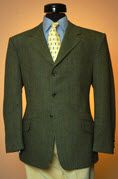
A cubhunting or hacking jacket has slanted pockets with a three-button front. Traditionally, women’s jackets had side vents and gentlemen had a center vent, but today’s environment provides an opportunity for the wearer—man or woman—to choose what looks best for his or her body shape. If one has a pronounced backside, side vents are more aesthetically pleasing.
When choosing a hacking jacket, select a color and pattern that is complementary to your build and coloring. Shirts can be any color and pattern that look well with the jacket. A patterned or colored stock tie is sometimes worn during cubhunting season. Tattersall vests may be worn, as well. The stock tie and vest are good ways of keeping the rider warmer as the days become cooler, especially during the regular hunting season.
Riders wearing tweed jackets should wear dark brown, cordovan or British tan field boots. Black dress boots are not really appropriate with informal attire nor are black field boots correct, but both boot styles have become acceptable in some hunts. The rider may wear three-buckle boots instead of the field boot.
Both dress and field boots are tall boots, which reach to just below the knee; the field boot has laces at the ankle and the dress style has none. With either style, boots should be tall enough to hit just at the back of the knee when the rider’s leg is bent.
Breeches are to be rust or tan; there are several shades of tan that are acceptable. Fashion colors and patterns on the breeches are not allowed. Young riders, usually riding ponies, wear jodhpurs and dark brown paddock boots with brown garters.
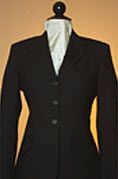 During a formal hunt, a member of the field (the general membership or guests, not the staff of the hunt) should wear a jacket that is dark in color—black or charcoal gray for men and black, charcoal, or navy blue for women. Coat buttons should be plain. The jacket can be a hacking jacket or a proper hunt frock. A frock coat has a tailored top, a waist seam, and a slightly fuller skirt. The waist seam of a hunt frock sits at the top of the wearer’s hip bone. The skirt tends to be longer in length than a traditional riding jacket to assist in keeping the rider warm and dry in inclement weather.
Hacking jackets and frock coats worn by field members and guests have three buttons and round corners. Field Masters, huntsmen, and whippers-in generally wear scarlet coats, sometimes known as “pinques,” with the hunt’s colors on their collars. Many women Masters have decided to wear navy blue frock coats with brass buttons. For many years women were not allowed to wear scarlet coats or brass buttons.
Staff and members of the field who wear scarlet coats should also wear black dress boots with tan or brown tops. (Women members who have earned their colors should wear black dress boots with black patent leather tops.) Canary breeches are the traditional color for scarlet and formal coats. Today it is difficult to find this color. White breeches are always correct with formal (frock) coats, but tan or buff breeches are also acceptable.
Buttons and the shape of the front corners on a frock coat inform other riders who the wearer is in the hierarchy of the hunt. This identification system goes back to English military uniforms. A coat with five brass buttons on the front and square corners is the huntsman. Only the huntsman wears this many buttons on the jacket. Whippers-in and Masters wear four brass buttons and square corners on their coats. The exception is for the Master who also hunts hounds; this person will wear five buttons.
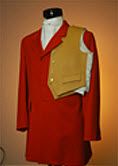 Men who have earned the privilege to wear their hunt’s colors are allowed to wear scarlet coats and engraved brass buttons. Women members who have earned their hunt’s colors wear the colors on the collar of their navy or black coat with engraved black bone (now often plastic) hunt buttons.
The fabric of formal hunting coats is determined by the type and amount of abuse that the jacket will undergo, be it from terrain or hounds and the climate. Traditional fabrics are cavalry twill and Melton wool. Cavalry twill is available in many weights up to thirty-two ounces, which is very heavy. Fabric is weighed by the yard, and there is an average of two-and-a-half to three yards in each riding coat.
Under the formal coat the rider often wears a canary vest. This vest can have brass buttons, plain, or engraved. It may have wool front and back or it might have a satin type fabric in the back. This is determined by how warm the rider needs to be when hunting.
Generally a shirt with white cuffs is worn under the vest for formal hunts. A white stock tie is placed on top of this. A four-fold stock tie is traditional. This style goes back to the beginning of foxhunting.
Those who either do not want the added bulk and maintenance or feel it is too difficult to tie, wear a version of a shaped stock tie. Unfortunately the shaped ties do not have the extra benefits the four-fold offers.
The four-fold stock is a piece of white fabric that is ten inches wide and two yards long. In addition to its use as an article of clothing, the stock tie has many other potential applications. It can be used as a bandage for animal or human. (Being white, one did not have to worry about any dye leaking into the wound.) Broken arms and collar bones were common injuries while chasing the fox, making this piece of fabric handy as a sling or as a figure-eight bandage. It can be used as an extra rein if a leather one breaks. And it can be used to lead an errant hound.
The stock pin ought to be a simple safety pin design in brass or gold. It ought to be placed horizontally. If used in a vertical position the wearer takes a chance of jabbing it into the throat if an accident should occur. This pin may be used to fasten the fabric when used as a bandage.
Many riders enjoy the comfort of gloves. They are worn to protect hands from weather or rough reins and to improve the rider’s grip on the reins. During warm weather a glove with a crocheted back and leather palm is recommended. Formal hunts require either white string gloves or dark leather.
For formal hunting, most hunts require black dress boots. While some hunts are now willing to accept black field boots, they are not correct. Because most riders acquire their boots ready-made from stores or catalogs, the selection of styles and finish details are serviceable but somewhat restricted. If you decide to have your boots made to your own specifications, there are several key considerations.
For foxhunting, the most practical boot has the leather rough side out. This does require a bit of extra work on the part of the person polishing the boots. One must have an old bone that has been properly prepared for such work. Boots with the rough out are handy for they hide scratches and small tears due to brambles. When the polish is applied to the leather it is rubbed into the leather with the bone, thus eliminating the scratches and scuffs made during the hunt.
Shirts have the collar and cuffs snug enough to eliminate the possibility of cold air flowing down the neck or up the arm. A snug arm hole eliminates the bat wing effect. This allows the jacket to fit more comfortably and reduces the annoyance of the shirt pulling out of the breech’s waistband.
Vests are to be long enough to cover the small of the wearer’s back and their belt buckle in front. Once again a trim fit is recommended for comfort and aesthetics.
A properly fitted jacket has a trim silhouette on the body, whether the person is small or large in size. Across the shoulder blades there must be enough room to move the arms forward when jumping over a fence. The sleeve length allows for a small amount of cuff to be visible when the arms are bent at the elbow holding the reins. The back of the jacket is to fall at the crease in the top of the thigh where it joins the buttocks.
As you plan your foxhunting wardrobe, you have many options: local tack stores, online and direct mail specialty catalogs, and consignment stores specializing in the needs of the foxhunter. For those who desire more selection there are custom tailors and boot makers. In the case of both boots and clothes, while the expense can be greater when made to your specifications, the end result is a garment that fits you better and lasts longer. It can be well worth the investment, both in terms of quality and in the peace of mind that comes from knowing that you are every bit as well turned out as your mount.
Posted June 5, 2012
Patricia (Trish) Bosley is the President of Bosley Brangier Custom Hand Tailored Apparel located in St. Michaels, Maryland. Founded in 1994, Bosley Brangier specializes in custom-made business and equestrian clothing for both men and women. Trish also provides individual wardrobe consulting advice to business professionals throughout the Mid-Atlantic region.
Bosley Brangier will hold an Open House on Thursday, June 28, 2012 in Saint Michaels, Maryland from 1 to 7 pm, featuring a program of short informative talks on hunting attire and offering light refreshment. MAWK President Jay Young will speak during the cocktail hour.