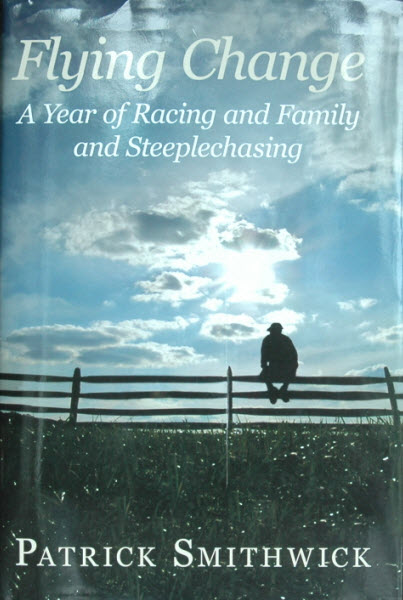
 Flying Change: A Year of Racing and Family and Steeplechasing by Patrick Smithwick, Chesapeake Book Company, 2012, 360 pages, $30.00If you can avoid disabling injury, horseback riding is a sport that many enjoy for a lifetime. All of us have heard anecdotal tales of people who ride—and even foxhunt—up into their seventies and eighties.
With Baby Boomers aging, those stories will become more prevalent, although many of us may be opting for the dressage arena instead of the hunt meet…or the race track.
Author Patrick Smithwick decided to meet growing older head on. He challenged himself at age forty-six to ride in the Maryland Hunt Cup, a four-mile timber race over twenty-two solidly built fences that are not for the faint of heart. It is the world’s stiffest timber race.
Smithwick, a teacher and author who lives in Elkridge-Harford Hunt territory in Maryland, didn’t just wake up one morning and decide, “I’m going to ride a horse in one of the toughest races in the world.” Steeplechasing is in his blood, and he was raised on horseback. His father, legendary jockey A.P. “Paddy” Smithwick and his uncle, renowned trainer D.M. “Mikey” Smithwick, are both enshrined in the Racing Hall of Fame at Saratoga Springs. The younger Smithwick, aka “Young-Blood” as Mikey calls him, put himself through college riding races. He stowed his racing gear away when he married and had three children.
Smithwick paid tribute to his late father in his earlier well-received memoir, Racing My Father. But his new book, Flying Change: A Year of Racing and Family and Steeplechasing, is an examination of his own life and his racing heritage, a book for his children. As the mid-life mark looms and Patrick considers that he has lived longer than his father, who died at age forty-six, Young-Blood hears the siren call of the post.
While on vacation at Saratoga Springs, Smithwick finds himself getting up at 5:30 a.m. to gallop racehorses for his friend, trainer Thomas H. Voss. Most men at this age, the author muses, develop a paunch, drink, play golf…“they don’t jump up on a three-year-old racehorse that is fueled and trained to the point that he is about to explode with nervous energy.”
Passionate about his wife, his family, and his writing, Smithwick decides he must risk his orderly life for the chance to ride at speed over jumps again. He realizes that writing—the “walk, trot, gallop, breeze the pen down the fresh-harrowed lines of [a yellow] pad”—can’t make up for a life without challenge. As he notes, there is a difference between reading—or writing—about the things that stir the human soul and doing them.
Smithwick turns to hunting with Elkridge-Harford to prepare his body for the rigors of racing. Those of us who hunt identify with his glee when hounds are baying and the horses are galloping and his horse flies over a wall with a mighty leap, just avoiding a hound that has shot out in front of him. Living in the midst of hunt country, it’s easy for Smithwick to tack up his mother’s gelding for a hack over the rolling Maryland countryside, a reminder that too many of our fellow Americans no longer experience the joys of an active, outdoor life. Those of us who face long drives to ride our horses at farms hemmed in by subdivisions envy Smithwick, longing to gallop freely across fields as he does.
Integral to Flying Change is a sense of place—links to who we are and where we come from that so many Americans dwelling in cookie-cutter housing no longer experience. Living in Maryland with his mother, uncle, and lifelong friends close by, Smithwick is surrounded by memories that he embraces and tries to share with his children. He is every parent who fights the lure of electronic devices as he tries to instill a love of horses and riding in his children.
Smithwick is as deft with a pen as he is with a skittish two-year-old, and his love for horses is obvious in his description of four bettors eying young Thoroughbreds in the paddock before they are tacked up: “To this quartet they are betting interests, not individual live beings with personality traits, athletic eccentricities, hearts, and nervous quirks; they are not youths who have left their friends back at the barn, who were led away from the gentle galloping girl whom they felt calm around…they are not adolescents with creases of fear rippling up their spines and a new sensation of claustrophobia pressing in on them as this herd of humans squeezes in closer…not allowed to react as nature has trained them for over two thousand years…”
Anyone who rides will instantly recognize the subtle meaning behind the title, and Flying Change with its lovely, descriptive writing is a delight for those of us who are constantly awed by horses and their generous gifts to us. And for those who don’t ride, Flying Change is an explanation of why people are so passionate about horses and horse sports.
One of the nicest touches in Flying Change is that Smithwick gives us a lesson in how to ride the challenging Maryland Hunt Cup course from the man who was expert. Smithwick takes us on a course walk with Uncle Mikey, winner of a record six Hunt Cups. Smithwick begins each chapter at a different jump, with Mikey’s advice on how to tackle it…and how to ride the race between the fences. “In the air,” Mikey says, “you need to be looking at the next fence.”
That’s good advice for all of us, especially if we are making our own flying change.
Posted May 1, 2012