On the Road: A Huntsman’s Perspective
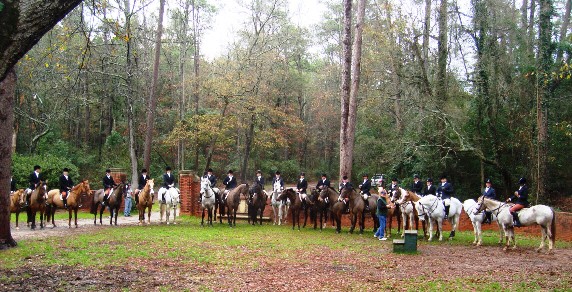 Visitors from the Rappahannock Hunt at Memorial Gate in the Hitchcock Woods for a meet with the Aiken Hounds / Karen Raiford photo
This article—about foxhunters on the road and the joys of visiting—is being published in four installments: 1. A Huntsman’s Perspective, 2. One Master’s Perspective, 3. Another Master’s Perspective, and 4. A Member’s Perspective. Here is the first installment.
On January 20, 2012, members of the Rappahannock Hunt left the familiar hills and mountains of Virginia for the mostly flat, somewhat sandy hunting territory along the border between South Carolina and Georgia. Some of us have been making this pilgrimage for more than fifteen years now.
With trucks fueled, trailers packed, horses wrapped and munching on hay, the group gathered in Madison for a planned 6:30 am departure. Where were the hounds? Not to fear, the huntsman pulled in shortly behind schedule with horses, hounds and the resident vet all in tow. The hounds, already knowing what was in store for them I am confident, greeted the group with all twenty-five heads hanging out of the trailer and sterns held high. It was time to “kick on.”
Thirty members had signed on for this trip. Twenty-three members would be riding, so you can imagine the caravan heading down Route 29. Our first destination was Aiken, South Carolina. Here we would stable the horses for a few days as we hunted with the Aiken Hounds in Hitchcock Woods and with Whiskey Road on Sunday. All twenty-five hounds were provided the best of accommodations within the Whiskey Road kennel.
The Aiken Hounds provided great sport on day one. A field of nearly sixty riders was gathered at Memorial Gate for introductions and a welcoming stirrup cup. Conditions were damp with heavy rains forecasted. Master Linda McLean made introductory remarks before leading the group to the first cast. There would be three casts in all. First flight was made up of approximately one-third of the riding participants with the remainder filling the ranks of second and third flights. Each cast and corresponding chase was made up of twenty or so jumps, beginning and ending with the traditional Aiken jumps with a series of hedge jumps in the middle known as Cathedral Isle. In all, some eight to ten miles were covered with the heavy rains indeed arriving midway through the hunt. Fortunately we were well prepared for the conditions and had the promise of a fine breakfast and warming beverages to see us through.
Day-two belonged to the Whiskey Road Foxounds who were graciously mixing packs with Rappahannock for a joint meet. I had been fortunate to get to know Master Lynn Smith years earlier on a previous trip, and we have mixed hounds several times since. The conditions before us on this day were not promising. The temperature had dropped eight degrees from the time hounds departed kennels. At the first cast, the temperature hovered around forty degrees with a high level of humidity providing a raw feel to the air. Worst of all, a breeze that would soon change course to that of the dreaded east wind was present.
Whiskey Road huntsman Joseph Hardiman and myself cast the hounds through a stand of pines with thick undercover in the direction of the swamp. Down south I have learned that swamps hold great promise of sport. Each territory seems to have them but no two are alike. This one was roughly twenty-five yards across and seemingly a mile in length. Hounds feathered their sterns along the way with a brief vocal exchange early in the cast, but this was not the run we were looking for. A true line no doubt, but old, so we passed it by.
Further down along the swamp renewed excitement was displayed by the mixed pack. They plunged into the depths of the swamp, ignoring razor sharp thorns and dense brush. My heartbeat quickened as I grabbed for my horn and awaited the most beautiful moment a huntsman gets to experience—the strike. I was not to be disappointed as the pack erupted. Rappahannock Marksman was the first voice I heard, followed by the pack in its entirety. They had flushed the coyote from his hiding spot. I doubled Gone Away on the horn as Joseph kicked on to get a view of our quarry. We arrived on the other side in time to see Marksman and Whiskey Road Foreman in the lead across some recently logged country. The pace was quick, and the voice loud as the packed pursued. In all the run proved to be short lived as the coyote exited the country about twenty minutes into the run. While in the swamp the pack could chase with ease, but as our quarry left the swamp and crossed over the pine tree covered hill we fell victim to the aforementioned east wind. Over the next hour or so, great effort was made to finding another willing coyote but it was not to be. The day’s hunt was called to an end, so the hunt breakfast could begin.
Having now relocated to the Belle Meade kennel and stable complex, the group headed about forty-five minutes down the road for a joint meet with the Shakerag Hounds. Conditions this day were unlike any we had faced. The temperatures were forecast to reach a high of seventy with ample sunshine. Master Sally Rasmussen and others welcomed our group before heading out.
Rolling wooded hills were the order of the day, accompanied by a swamp of course with a river off to one side. Bobcats, coyotes, fox, and hogs all abound in this country on most days. Unfortunately, this day would prove to be the exception. We all have these days in our own territory and should not be surprised when one is experienced in another’s. It is not often I enjoy a blank day, but I admit that I did so this day. Hounds worked incredibly hard to provide sport, as did Shakerag huntsman Jon Eaton and I. Both packs had young and old entry present. Not one young hound went off on riot the whole day, and trust me when I say no stone was left unturned. The members of Rappahannock enjoyed the warm temperature and the fellowship. A huge breakfast was enjoyed upon returning to the meet site, and we returned to Belle Meade.
Our last day of hunting was a joint meet with Belle Meade Hunt. As is customary, the hunt began at 3:00 pm. Belle Meade Master and huntsman, Epp Wilson, long ago found that they experienced their best hunting in the late afternoon. It was another warm day, even more so than the day before, so much time was spent visiting with one another before giving serious attention to making the first cast. After about thirty minutes the pack struck a coyote line. Initially, the hounds had to focus their collective effort to identify the exit strategy used by our quarry. Once the path had been determined by the more able hounds within the pack, all others joined in the effort. We were now off! Over the next two hours the hounds provided constant pressure on what would be confirmed as a black coyote. The riders guided their mounts over the hills, down into the creeks and out again, over the many timber bridges, through the pine tree stands, and over the coop jumps as they came in our way— all of this at tremendous speed. By the end of the run, which the black coyote could claim victorious, some eighteen miles had been covered by the front running hounds. The once large pack had admittedly been reduced in size no doubt due to the extreme temperatures. The fine folks at Belle Meade put on the most glorious of feasts afterwards, which was consumed with much appreciation and promises to return again next year.
Our group is a special one indeed, and this trip is but one example of how we get together to enjoy the sport we love. Over the years we have had the great pleasure of making many friends through this journey, both Virginia neighbors that we come to know better as a result of shared experiences and the many South Carolinians and Georgians who share in the sport we all love. Foxhunting is like a language we all know how to speak, and without language barriers, it is only a matter of time before friendships materialize.
Posted March 27, 2012
Michael Brown is huntsman for the Rappahannock Hunt (VA).