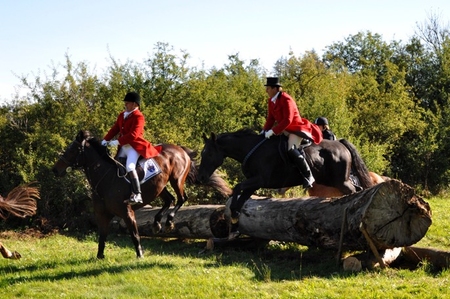
 If you look closely at this photo, you will see Field Master Vaclav Vydra (top hat) hunting his horse in a neckstrap only—no bridle, bit, or reins. / Noel Mullins photo
Most visitors to the Czech Republic rarely travel further than the city of Prague. But the beautiful countryside and its tiny villages offer another side to the country and remind one of a bygone era.
An opportunity to hunt with Prince Johannes Lobkowicz, a member of one of Bohemia’s noble families, on his magnificent estate in the village of Drahenice south of Prague was not to be missed. The Prince hosts up to four meets per year, and hunt followers came by invitation from Germany, Hungary, Austria, Canada, Poland, America, and Ireland.
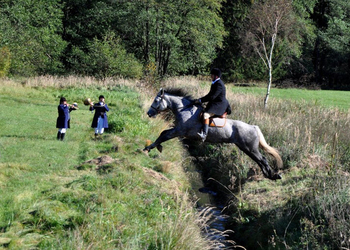 Prince Lobkowicz flies a ditch on his Irish hunter to the accompaniment of an appropriate fanfare! / Noel Mullins photoNo stranger to Ireland, Prince Lobkowicz has hunted frequently with the Stonehall Harriers and the Limerick Harriers. He has three Irish hunters in his stables sourced through Aidan O’Connell from John McNamara, John Breen and Mikie O’Riordan in County Limerick. O’Connell has been travelling the world teaching riding skills for over thirty years and has sourced Irish hunters for hundreds if not thousands of riders in Europe and in America.
It has not been easy for the Prince’s family. They were dispossessed of their properties by the Nazi occupation in 1937 and then by a Communist regime in 1948. After the Velvet Revolution of 1989, progressive laws by the Czech Republic Parliament like fifteen percent income tax, no capital gains or inheritance tax, and most importantly a Repatriation Law allowed dispossessed families to reclaim their land and possessions.
However, when Prince Lobkowicz got his estate back in 1992 it was in a dilapidated condition. The castle had been used by the Army for storage, and they covered the lawns with asphalt for parking their tanks. The roof fell into disrepair, no water or electricity, and dampness damaged the buildings and the fifteenth century murals on the ceiling of the tiny church. Today the Prince and his wife Joanna, whose son was educated in Rockwell College in Tipperary in Ireland, have put all their savings into what is now a magnificent home, and he has changed career from banker to farmer. He is also providing badly needed local employment in working three thousand acres of woodland and another three thousand acres of farmland, growing wheat and rearing carp in ponds for the German and Czech Republic markets.
Hunting
A full weekend of hunting and social programme started with a get-together dinner in the local Equitana Hotel in Martinice, which is also an equestrian centre and venue for the Annual Czech Republic Show Jumping Championship. Breakfast in the castle banquet hall echoed to a fanfare of French horns sounding one of the fifty-one hunting calls—on this occasion Raveil, or the Wake Up call, and Summon to the Meet by a group of horn blowers, Main Parforce from Aschaffenburg.
Huntsman Otto Shultz travelled from Germany with twenty-seven couple of Asbach Foxhounds—all Irish drafts from the County Clare, County Limerick Harriers, Tipperary, Old Mill and Kilkenny. They assembled on the castle lawns to the sound of Prince Lobkowicz Fanfare. The three grey hunters ridden by the hunt staff—Otto Schultz, Berndt Bleser and Wolfgang Tehl—were from Tom Burns through Aidan O’Connell and Jim Derwin’s yards in Ireland through Hans Nagel. The new Joint-Master of the Asbach, Alexandra ‘Sandy’ Kroell, was on another Irish hunter from Austin Quigley. Her sister Diana competed in the European Championships in 1991 on an Irish pony, Powder Monkey, and her father Juergen will be well known for purchasing hundreds if not thousands of Irish horses over thirty-five years. Dunja Peysang, Jens Thalheim, and Tilman Pagel were on Irish horses also.
The castle lawn was crowded with villagers and visitors who saw an array of red, blue, and green hunt coats, including one Polish lady in a black jacket who rode side saddle. Another fanfare signalled Sit Up to the Hounds and Prince Lobkowicz’s Fanfare. Setting off from the castle the drag team set a three kilometre run near the cattle herd over a mixture of natural and man-made fences. Many of the fields were a hundred acres in size, and in some instances up to five hundred acres, a throwback from the days of the Communist Co-Operatives.
It was interesting to see Jan Vedral hunting his Thoroughbred in a light cord head collar, but Fieldmaster Vaclav Vydra, the Czech superstar of television, stage, and film, has a unique way of training his horse Damon. He rode all day over uprights, ditches, banks, and drains without a head collar, bit, reins, or bridle. He uses only a halter rope around the horse’s neck close to the withers, and rides mainly with his legs. Barbara Keikova rode his other horse Gustav in the same way. Nor does Vydra believe in shoeing his horses, preferring to trim his horse’s hooves on a regular basis himself. Lucia Baresova, who studied filming in University College Cork and keeps her horse in Vydra’s stable, trained the same way.
Abandoning the drag, hounds broke first on a roe deer and then on a fox before hunt staff managed to get them back on the line. Before hounds were laid on the second line by Malkov Lake there was another fanfare on the French horns. The Prince had added a few deep and wide ditches to this line, the inspiration obviously coming from his experience hunting in Ireland.
Also hunting was Dr. Zsolt Visky-Hanka who had organised a hunt in Hungary last year and challenged followers with two novel cross country fences. He faced two large cannon guns towards each other, together with soldiers in uniform standing to attention each side, as well as another fence of an oxen cart with two patient oxen under the shafts.
Renee Hess, whose husband Michael is chairman of the Asbach Foxhounds, rode close to the front. She was riding Carlo, a Thoroughbred horse that she purchased from Hans Kuehnle’s Tullibard’s Stud in County Laois. He was riding The Sweeney from John McNamara’s yard in Limerick.
The third line was laid, and hounds hunted well—particularly a white hound named Clare, after the County Clare Hounds from where she was drafted. On this line the pack did a detour on a roe deer but got back on the line. Henrik and Isobel Kessel jumped side by side. Rudiger Slabon from Bravaria who has hunted in Tipperary has had five Irish hunters. He said that they are just “perfect for hunting.” Christian Von De Rettstadt was also going well on his Thoroughbred. Christoph Wichmann, who stays at The Dunraven Arms Hotel in Adare when hunting in Ireland, was on a King of Diamonds hunter. He was very complementary about hoteliers Bryan and Louis Murphy. The Austrian Army was represented by Captain Michael Deskovich and Colonel Franz Kartusch. Hounds had covered nearly 30 kilometres of fast galloping, and the followers had jumped everything from natural banks, drains, and ditches to well-made uprights.
Back at the castle speeches were made on the lawn, and the Curee Fanfare was blown to signal the Meal for Hounds, mainly associated with staghunting. Then the Halalli Fanfare was blown on the French horns for the end of the hunt and then L’adieu des Maitres or Goodbye to the Master. As a courtesy, each of the followers was presented with a small piece of a branch of a tree called in German, Bruchverteilung.
Dinner in the castle banquet hall began with a fanfare of French horns and then speeches. Aidan O’Connell appropriately paid tribute to the horse and the hound for bring the various nationalities together in friendship. Dinner consisted of barbequed venison and all the trimmings, while a Bohemian Folk Group complete with zimbalom, violins, and bass entertained the followers with Bohemian, Moldovian, Hungarian, Russian, Dutch, and German gypsy music that made the rafters vibrate well into the small hours of the morning. At dinner I met Joseph Novacek from the Fraser Valley Hunt in Canada, of which Aidan O’Connell was made an honorary member at his sixtieth birthday party last year in Hamburg.
One of the most interesting guests was Dr. Hans Peter Eidt, who told me that in 1959, as a sixteen-year-old, he had spent four weeks in Rosses Point in County Sligo in Ireland learning English. Remarkably he still remembered the Irish ballads and the Irish National Anthem in Gaelic, and he recited the poetry of W.B. Yeats, including the epitaph on his grave in Drumcliff Cemetery in County Sligo:
Cast a cold eye
On Life, on Death.
Horseman, pass by.
What a memory!
Posted December 18, 2011
Click to access Noel Mullins’s website.
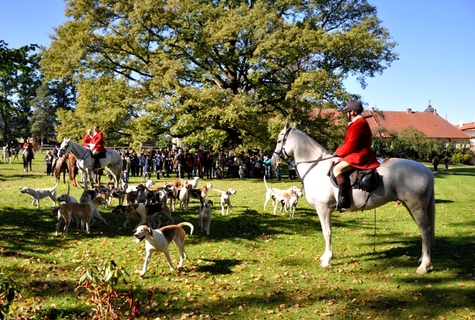 Huntsman Otto Schultz brought the Asbach Foxhounds (all drafts from Irish packs) from Germany to Drahenice Castle in the Czech Republic. / Noel Mullins photo