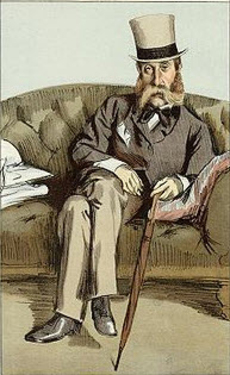
 George Whyte-Melville as caricatured in Vanity Fair, 1871You may have noticed that White-Melville and Ogilvie are my favorite poets. These two establish a cadence in their meter that transports me to the field atop a horse, rhythmically pumping his hindquarters and stretching his neck beneath me.
I was pleased to learn from the Dictionary of National Biography, edited by Sirs Stephen and Lee, that Whyte-Melville, being a gentleman of means, “devoted all the earnings of his pen…to philanthropic and charitable objects, especially to the provision of reading rooms and other recreation for grooms and stable boys in hunting quarters.”
This poem has long been a favorite of mine. Whyte-Melville, having been a major in the cavalry and having devoted his life to foxhunting, was an able horseman, I’m certain. Yet though he was thrown out this day, he expresses his admiration for the rider who left him in the dust.
Come, I’ll give you the health of a man we all know,
A man we all swear by, a friend of our own;
With the hounds running hardest, he’s the safest to go,
And he’s always in front, and he’s often alone.
A rider unequall’d—a sportsman complete,
“A rum one to follow, a bad one to beat.”
As he sits in the saddle, a baby could tell
He can hustle a sticker, a flyer can spare;
He has science, and nerve, and decision as well,
He knows where he’s going and means to be there.
The first day I saw him they said at the meet,
“That’s a rum one to follow, a bad one to beat.”
We threw off at the Castle, we found in the holt,
Like wild-fire the beauties went streaming away;
From the rest of the field he came out like a bolt,
And he tackled to work like a schoolboy to play,
As he rammed down his hat and got home in his seat,
“This rum one to follow, this bad one to beat.”
‘Twas a caution, I vow, but to see the man ride!
O’er the rough and the smooth he went sailing along;
And what Providence sent him, he took in his stride,
Tho’ the ditches were deep, and the fences were strong,
Thinks I, “If he leads me I’m in for a treat,
With ‘this rum one to follow, this bad one to beat.’”
Ere they’d run for a mile, there was room in the front,
Such a scatter and squander you never did see!
And I honestly own I’d be out of the hunt,
But the broad of his back was the beacon for me.
So I kept him in sight, and was proud of the feat,
“This rum one to follow, this bad one to beat.”
Till we came to a rasper as black as your hat,
You couldn’t see over—you couldn’t see through;
So he made for the gate, knowing what he was at,
And the chain being round it, why over he flew!
While I swore a round oath that I needn’t repeat,
At “this rum one to follow, this bad one to beat.”
For a place I liked better, I hastened to seek;
But the place I liked better I sought for in vain;
And I honestly own, if the truth I must speak,
That I never caught sight of my leader again.
But I thought, “I’d give something to have his receipt,
This rum one to follow, this bad one to beat.”
They told us that night he went best through the run,
They said that he hung up a dozen to dry,
When a brook in the bottom stopped most of their fun,
But I know that I never went near it, not I.
For I found it a fruitless attempt to compete
With “this rum one to follow, this bad one to beat.”
So we’ll fill him a bumper a deep as you please,
And we’ll give him a cheer; for deny it who can,
When the country is roughest he’s most at his ease;
When the run is severest, he rides like a man,
And the pace cannot stop, nor the fences defeat
“This rum one to follow, this bad one to beat.”
Posted December 16, 2011