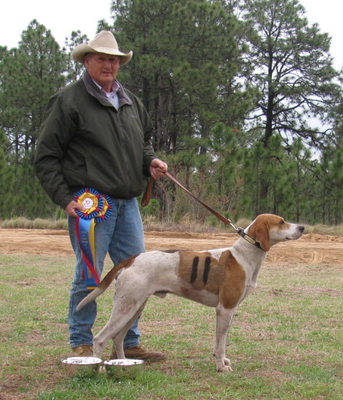
 Huntsman David Conner and Rockbridge Lawyer 2008. Jan Sorrells photo
Rockbridge Lawyer 2008 and his littermate Lead scored a one-two punch at the Carolinas Foxhound Performance Trials on March 26 and 27 in Hoffman, North Carolina. Competing against hounds from twelve other hunts, the Rockbridge pair finished first and second respectively after two days of hunting. We talked to Conner about his handsome and talented hound.
Trial organizer Fred Berry, MFH of the Sedgefield Hunt, has been actively involved in foxhound performance trials for years—first judging, then organizing. As a result of Berry’s considerable experience, he has introduced some interesting new wrinkles into the management of his trials to improve both the hunting and the experience for the field.
Hounds
Winning hound Rockbridge Lawyer and reserve hound Lead are Crossbred dog hounds from a strong Rockbridge male line out of a Rappahannock-bred bitch. Their other bloodlines go back to Midland, Loudoun West, Keswick, and Piedmont. Lawyer has been a consistent performer in the field at home and at the Carolinas trial last year, where he took second place.
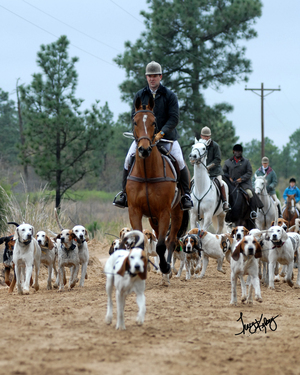 Trial huntsman Chad Wilkes and hounds Tracy Kelsey photoAnother Rockbridge hound, Cinder, placed eighth overall, helping Rockbridge to sweep the team competition with twice the number of points compiled by runner-up Full Cry Hounds (AL). Full Cry had two hounds within the top ten, placing fifth and ninth.
David Conner has been hunting hounds at Rockbridge for thirty-five years. He says if he has a star in his pack, Lawyer is it.
“Lawyer has been a hard-working hound all along, but this year he really stepped up,” said Conner. “He’s always busy, always looking, a hard running hound. We have an older bitch in the pack that has been the one to watch, but you can see Lawyer taking over that role. He’s always in the thick of it.”
Another Rockbridge hound, Cinder, placed eighth overall, helping Rockbridge to sweep the team competition with twice the number of points compiled by runner-up Full Cry Hounds (AL). Full Cry had two hounds within the top ten, placing fifth and ninth.
Hounds are judged over two days of hunting by mounted judges dictating their scores into hand-held voice recorders. Judges score hounds in four categories of performance: hunting, trailing, full cry, and marking. At the end of each day’s hunting, the judges’ information is entered into a computer scoring program. Each of the four performance categories is weighted differently by the program, which also computes endurance scores based on the time of day in which the other scores are recorded. Every hound and every competing hunt is ranked by its total score at the end of each day. At the conclusion of the trial the scores from both days are combined to produce the final overall rankings of hounds and hunts.
Participating hunts with hounds that made the final scoreboard included Cedar Knob Hounds, Full Cry Hounds (AL), Longreen Foxhounds (TN), Moore County Hounds (NC), Red Mountain Foxhounds (NC), Rockbridge Hunt (VA), Sedgefield Hunt, Snickersville Hounds (VA), Stonewall Hounds (VA), and Windy Hollow Hunt (NY).
A Breakout Year
This was the fifth consecutive year that the trials were held at the J. Robert Gordon Bird Dog Field Trial Grounds in Hoffman—nine thousand acres of open longleaf pine forest laced with thirty-six miles of broadly cleared trails.
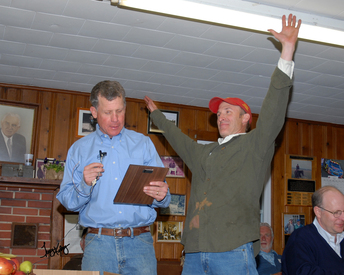 Trial organizer Fred Berry, MFH (left) and Lincoln Sadler, Moore County Hounds, in the field trial grounds clubhouse Tracy Kelsey photo“With 160 riders and twelve hunts participating, this was clearly a breakout year for us,” said Fred Berry. “That level of interest and participation was off the charts.”
“[Trial huntsman] Chad Wilkes did a super job,” Berry continued. “We had sixty-plus-six hounds in the pack—sixty hounds competing and six of Chad’s hounds from the Camden Hunt. Chad’s hounds weren’t numbered or judged.”
That’s a new idea, and I was interested. The primary benefit of this innovation is immediately apparent when one realizes that the trial huntsman is hunting a large pack of hounds that he doesn’t know and that don’t know him. Having his own hounds in the pack, Berry explained, gives the huntsman a known reference. Watching his hounds—their behavior and reactions—tells him what he needs to know when the pack starts to show interest in a line. Are they being honest or not?
“The huntsman gets a quicker read when he can see his own hounds working,” Berry explained.
Another innovation of Berry’s is to scrap the practice of numbering hounds randomly and instead group the numbers by hunt. The original reason for random numbers was to help preserve the hounds’ anonymity to the judges. However, Berry believes that everyone gets more enjoyment out of the hunting day by knowing, for example, that any hound numbered in the low 70s belongs to Moore County and any hound numbered in the high 70s belongs to Full Cry. In fact Berry passes out a complete list of hounds—names and numbers—to all the followers.
“Does anyone believe that the referees in an NFL game don’t know who’s playing for the Bears and who’s playing for the Packers?” asked Berry rhetorically.
Having judged a number of performance trials, I can attest that all the judges I know are watching for good hound work, and they score working hounds as they see them.
Some of Berry’s innovations transcend the sublime. A few years ago, Lili Wykle, MFH of the Stonewall Hounds (VA) was crowned “Cutest Huntsman” with a pink plastic tiara. The following year Wykle returned with her tiara and Anthony Gibbs, huntsman for the Low Country Hounds (SC) went home with the precious crown. This year’s queen, selected from a bevy of beautiful huntsmen, was Mitzi Cabeen from the Smith Mountain Hunt, who substitutes for her husband George when he is unable to hunt hounds.
“My sides are still hurting from the fun we had!” said Berry.
Posted April 6, 2011
Complete results are posted on the Sedgefield Hunt website.