
Installment Six
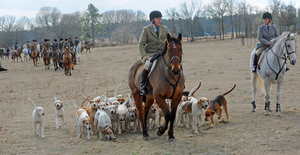 Whiskey Road huntsman Joseph Hardiman takes hounds, staff and field for a long day’s hunting.Betsy and friends escape frozen Virginia for a week of hunting in warmer climes. We bring you Installment Six of her daily blog, exclusive to Foxhunting Life.
Call it the Crown Jewel of Aiken, South Carolina.
The Hitchcock Woods is closely associated with Aiken’s early history as a winter resort for snow-weary northeastern sportsmen starting well before the turn of the last century. Originally, the Hitchcock Woods was part of a much larger tract purchased by legendary sportsman and horseman Tommy Hitchcock and William C. Whitney. In 1939, Hitchcock and daughter Helen Clark established the Hitchcock Foundation by donating twelve hundred acres of land near the center of the Aiken County seat. More land has been added since, making the public park nearly two thousand acres.
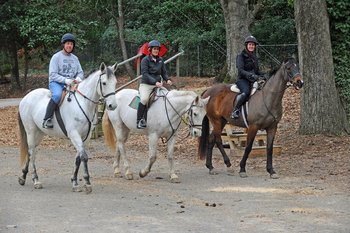 Tom Neel, Stephanie Miller, and Lore Farriss in the Hitchcock WoodsThe Hitchcock Woods offers the natural beauty and quiet solitude of a unique southern forest located in an urban area. The parcel is laced with well maintained trails, many wide enough for carriages (even four-in-hands), with “Aiken Lines” of eminently jumpable fences sprinkled throughout. There are several lakes, including picturesque Black Gum Pond, three bold creeks—Crazy Creek, Calico Creek and Cuthbert Branch, several open areas of native grasses and wild flowers—the Pokeberry Field, Dove Field, and Pileated Patch, three “playgrounds” with schooling jumps of varying sizes—the Menage, the Crawford Fences (at the center of the Ridge Mile Track, a mile-oval at the top of the tallest hill in the Woods) and Captain Gaylard’s Fences (a wee line of mini “Aiken Fences” about eighteen to twenty-four inches tall that are perfect for starting a young horse jumping.) The Woods are otherwise just that—lovely mature forest of pine, oak, holly, a few magnolia and other native hardwoods. The Foundation over-cuts occasionally, and does controlled burns to keep down invasive non-native growth and encourage the jubilant native plants and flowers that thrive in the humid-dry-hot-freezing climate of the mid-South.
Perhaps the most unique feature of the Woods is the Sand River, literally a river of sand that “flows” through the eastern edge of the park. Parts of it warn “quicksand” but where we crossed during our hack Wednesday was simply deep-ish sand.
It rained and iced a bit Wednesday night, but the forecast was for gradual clearing in the morning. Whiskey Road Masters Gail Flintom and Lynn Smith moved the meet back to eleven a.m. to allow for more clearing and drying, so by the time hounds moved out from the Drafts’ property northeast of New Holland, it was full sunshine and warming temperatures.
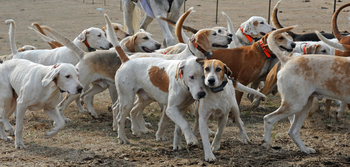 Hounds drew northwest across the back pasture and crossed the Old Chalk Road before striking and moving towards the Jackson fixture (where we met the first day of Hunt Week.) They could not carry (I’d suspect due to the light but persistent breeze that accompanied the tail end of the high pressure system that had ushered out last night’s rain). Huntsman Joseph Hardiman lifted them, and we crossed the Broken Dam over to a swampy area near the campground off Kirkland Road. Hounds struck hard, and blazed off on not one but two (viewed and halloaed) coyote. A few hounds went with the coyote that headed deeper into the Jackson property, but most of them stayed with the other which crossed Kirkland and streaked towards (busy) Highway 39. Staff radioed for wheel whip Antony Gaylard (the recuperating Toronto and North York huntsman) to try to keep them from crossing, but the game turned before the road and began a big circle back toward the original covert. Hardiman finally picked up hounds after a grueling four-and-a-half hour day’s hunting.
“It was the best hunt of all,” said Sidelines magazine editor and Second Field Master Cornelia Henderson. “By 2:30 my flight was so far out, we had an hour’s hack back to the trailers. Since I lead the non-jumpers, I couldn’t take the short cut home over the fences so we headed in. Got back after 3:30, and the first flight came staggering in closer to 4:30, having bee out since eleven.”
When coyote first come into an area populated by foxes (red or gray), they tend to run straight away, and fast, often taking hounds and riders right out of their territory. This is how it was, Master Lynn Smith said, when Whiskey Road’s horn was carried by Australian Darren Haussler some years ago. But eventually, after coyote become established in an area, being very territorial they tend to run more like a red fox, making a bigger circle, to be sure, but staying within their country.
There were fewer riders out today—maybe fifty or sixty. The Masters said it was because many of the Hunt Week guests had already left to get ahead of any bad weather forecasted, and many others were “out of horses” due to the busy hunting week.
The field reconvened at the home of Sidelines publisher Samantha Charles at her Hatchaway Bridge horse community for “breakfast” (which was supposed to be lunch, but ended up … well … as dinner). There, we joined in a hearty, if off-tune, rendition of “Carolina In The Morning.”
Nothing could be finer
Than to be in Carolina
In the Moooo–ooo—rrrrr–nnn-iii–nnn-gggg.
If I had Alladin’s lamp
For only a day
I’d make a wish
And here’s what I’d say
Nothing could be finer
Than to be in Carolina
In the Mooo-rr-nn-iiii-nnn—ggggg.”
It was a perfect and fitting end to our Hunt Week tour. Tomorrow we meet with Richard Lamb for a morning lesson here at Full Gallop (flatwork, grid work, then maybe some cross country). In the afternoon I’m going into Columbia with Tom to visit his alma mater, the University of South Carolina. Saturday we have a date to meet some others downtown for a hack along the sand roads around the horse district, including the training track and steeplechase course.
Posted February 11, 2011
For previous installments of Betsy Parker’s blog, click on Horse and Hound/Hunt Reports.