
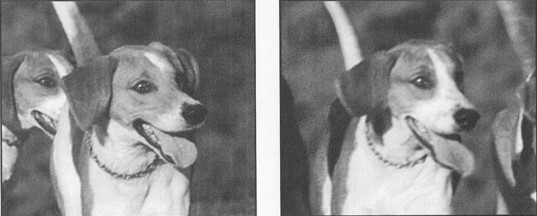
 An example of Maryland hounds, commonly called Irish hounds earlier in the last century, were bred at Howard County-Iron Bridge Hounds (MD) and entered in 1997. Green Spring Valley Outlaw and Howard County Freckles are descendants of Mountain and Muse, the pair of Irish hounds imported to Maryland in 1814. This strain of Maryland hound occasionally produces a litter with an uncanny resemblance to Mountain and Muse as sketched from life by their owner. Note the short ears, snipey noses, and white pattern on faces. The blood of Mountain and Muse runs in virtually every popular type of American and Crossbred foxhound hunting today. Including the July. / Barry Reightler photo
Before answering the question in our title, let’s start with a few confusing definitions. A puppy resulting from a mating between a male and female both listed in the registry of a particular breed of canine is a purebred of that breed. However, the same puppy might also be a crossbred of individual types or strains within the breed. Or the pup might be a carefully-bred example of one specific type or strain within the breed. Notwithstanding the possible permutations, this same puppy remains a purebred (so-called) of the breed.
For example, let’s consider what we know to be a purebred English foxhound. Actually, it’s hardly pure. There are many types (or strains) of English foxhounds in the English Foxhound Stud Book, yet every hound listed therein can be legitimately called a purebred English foxhound. Examples: traditionally-bred hounds as you would see in the Belvoir kennels; fell hounds looking more like American hounds in the Border country between England and Scotland; hairy, bearded Welsh hounds bred in Wales; modern English foxhounds bred only since the twentieth century.
So now that we agree on the language, what is a July foxhound? For our purposes, it is a purebred American foxhound of the July strain that is registered in the MFHA Foxhound Stud Book as an American hound. There are other types of American foxhounds in that registry: Penn-Marydel, Trigg, Walker, and others.
However, the more interesting questions are why was the July type bred in the first place? By whom? What were the breeders trying to accomplish? And what were the bloodlines that make this purebred American foxhound a July? Let’s talk about that now.
Arrival of the Red Fox
One day in 1730, according to several accounts, a group of tobacco planters on Maryland’s Eastern Shore were reminiscing about the “good old days,” chasing red foxes in their mother country. Hunting the less inspiring native gray foxes in Maryland did not match up, so the men resolved to improve their sport. The captain of the tobacco schooner Monocacy, owned by one of the planters, was instructed to bring back from Liverpool eight brace (16) of red foxes on his next trip. The foxes arrived in due course and were liberated along Maryland’s Eastern Shore with much fanfare, merriment, race meets, and a hunt ball!
However, as the years passed, the population of these imported red foxes grew. Their descendants spread north, south, and westward, expanding their range. Their appearance was thoroughly vexing for American foxhunters who had hardly ever seen a red fox. The America-bred hounds of the time were simply unable to cope with the fleeter quarry.
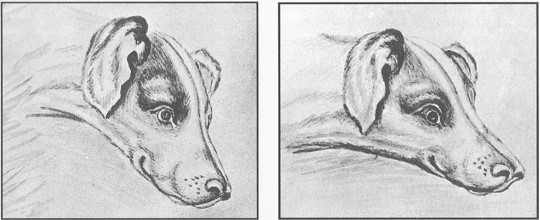 Mountain and Muse, the “Irish hounds,” imported to Maryland in 1814, provided bloodlines for every popular strain of American and Crossbred foxhound hunting today, of which the July hound, an important ingredient to the Hardaway Midland Crossbred, is one. / Courtesy of the Museum of Hounds and Hunting N.A. (See Afterword.)
Mountain and Muse
In September 1814, a merchant ship arrived in the Port of Baltimore and disembarked two foxhounds from Ireland, Mountain and Muse. Unusual in appearance, speed, aggression, hunting style, and prepotency (ability to pass on their genetic characteristics and attributes to succeeding generations of their get), Mountain and Muse turned out to be progenitors of our principal American foxhound strains: July, Birdsong, Trigg, Bywaters, and Walker. The Midland Crossbred developed by Ben Hardaway, MFH, in the latter half of the twentieth century and found today in kennels all over North America as well as England has its roots in Mountain and Muse through the July strain.
The Odyssey of Mountain and Muse
In Britain, the Duke of Leeds, who had married a daughter of Charles Carroll of Baltimore, gave the two Irish foxhounds, Mountain and Muse, to a visiting guest, Bolton Jackson of Baltimore. Jackson, upon his return to Baltimore, presented the Irish hounds to Colonel Sterrett Ridgely of Oakland Manor. One American admirer of Mountain and Muse wrote:
They were remarkable as are their descendants, according to the degree of the original blood, for great speed and perseverance, extreme ardour, and for casting ahead at a loss; and in this, and their shrill chopping unmusical notes, they were distinguished from the old stock of that day; which when they came to a loss, would go back, and dwelling, take it along, inch by inch, until they got fairly off again, whilst these Irish hounds would cast widely, and by making their hit ahead, would keep their game at the top of his speed, and break him down in the first half-hour. (−American Turf Register, February, 1832, p. 287)
Although Mountain and Muse were prized for their ability to cope with the fleet, straight-running red fox which had been increasing in number since their importation and release in Maryland in 1730, Colonel Ridgely found them to be too much of a handful to keep, and the two hounds came into the hands of Benjamin Ogle, Jr. (grandson of Samuel Ogle, Proprietary Governor of Maryland during Colonial days).
Mr. Ogle told me [Mountain] was as famous for running dogs as foxes, and frequently he had so annoyed [Col. Ridgley] he at last directed his neck to be put under the fence–the common mode of executing a condemned dog. Mr. Ogle, seeing he was determined to kill him, asked not only for his life, but for the dog; and, in that way, preserved a most valuable breed. (−American Turf Register, January, 1833, p. 234)
Benjamin Ogle, Jr. bred a pack of foxhounds from Mountain and Muse, including the famous Sophy whose portrait he hung in his library at Belair, the Ogle family Maryland estate. From Belair, Mountain and Muse went to Charles Carroll, Jr.
[Mountain] was a very compact dog, of middling size, and what in cattle, in England, is called flecked, not spotted, with large dull blue greyish splotches–such at least was his appearance when I saw him at Homewood, the residence of C. Carroll, Jr. to whom he had been presented by Mr. Ogle. (−American Turf Register, February, 1832, p. 288)
Mountain, Muse, and their progeny were familiarly known as the Irish hounds in Maryland. The pair was finally separated when Mountain came into the possession of Dr. James Buchanan, who lived near Sharpsburg, Maryland. But Mountain and Muse had already produced foundation progenitors of premier American hound types to come, the blood of which is still highly prized and carefully nurtured by today’s preeminent foxhound breeders of both mounted packs and field trial foxhounds.
Captain
From Dr. Buchanan, Dr. Thomas J. Henry of Virginia (Patrick Henry’s grandson) obtained Captain, said to be the greatest stallion hound of his day. Captain, by Traveler out of Benjamin Ogle, Jr.’s Sophy, was highly inbred according to both van Urk and Hayden Trigg; both his sire and dam were by Mountain out of Muse. (−The Story of American Foxhunting, Volume I, J. Blan van Urk, Derrydale Press, 1940, 1941, p. 134 and The American Foxhound, Hayden C. Trigg, 1890, fold-out pedigree between pp. 80 and 81)
It is said about [Captain] that he had no equal when it came to speed and endurance. When ordered south for his health, Dr. Henry took his pack from Virginia to Florida. [Threatened by alligators in the bayous and lagoons,] they were taken to Georgia; and Mr. G.L.F. Birdsong of Thomaston, Georgia, who had come into the Doctor’s life, became the proud owner of the, by then, famous Henry pack.
The results of this acquaintanceship and acquisition are the Birdsong or July hounds of Georgia (July having been the name of a hound [tracing back to Captain] belonging to Nimrod Gosnell, a Maryland farmer). The well-known Trigg hounds of Kentucky are also descended from the Henry, Irish hounds. (−The Story of American Foxhunting, Volume I, J. Blan van Urk, Derrydale Press, 1940, 1941, p. 134)
Nimrod Gosnell’s farm, where July was bred, actually comprised a portion of the original “Manor Land” granted to Charles Carroll. George Linthicum lived nearby as did John Hardy. Those three men founded the Howard County Hounds (MD) and created its first pack from their own Maryland (or Irish) foxhounds.
The July Strain
In the mid-1800s, Colonel Miles Harris in Georgia imported a pair of puppies from Maryland. He named the dog puppy July and named the bi*ch Mary. The puppies were direct descendants of Mountain and Muse through the famous sire, Captain―only two generations behind Mountain and Muse himself and highly inbred to both. Captain’s sire and dam were both by Mountain out of Muse.
July earned a superb reputation as a brilliant hunter and is the foundation sire of the strain of foxhound known today as July. Col. Harris bred July to his best bi*ches, and his Georgia foxhunting friend took their best bi*ches to July as well. July later wound up in the hands of Birdsong, who used him. Birdsong was well familiar with the Mountain and Muse bloodlines and had already bred from them. The hunting style of July’s descendants appealed to other foxhunters who carried the breeding on well into the twentieth century and to the present.
The late Ben Hardaway (Never Outfoxed, 1997) from Midland, Georgia, was also besotted with the hunting style of the July type, as was Hardaway’s older friend and mentor in Midland, Georgia, the late George Garrett (Fifty Years with Fox and Hound, 1938). In his book, Garrett gives an account of Col. Miles Harris’s acquisition of his now-famous foxhound, July, now the namesake and foundation sire of a highly admired strain of American foxhound.
According to Garrett, Col. Miles Harris was the most extensive planter in middle Georgia in the mid-1800s. Col. Harris occupied a handsome two-story residence surrounded by equally beautiful grounds and gardens designed by a landscape artist. “He was a large slave owner and built houses for them made of brick, the duplicates of which were not to be found on any plantation in the entire south,” Garret adds.
Up until 1858, Col. Harris maintained a pack of fifteen to twenty hounds under the supervision of a groom whose sole duty was to feed and care for them. Col. Harris was discouraged by the hunting, however. The red foxes, descendants of the English red foxes imported to Maryland by the Colonial planters more than a century earlier, were spreading into Georgia, and his hounds could not cope with the speed, endurance, and range of this new quarry.
During a visit to a farm stock market in Cincinnati, Col. Harris met Ben Robinson of Mount Sterling, Kentucky. After completing their business, it was only natural that the conversation drifted to foxhunting, the result of which was an invitation for Harris to visit Robinson’s home and join him in an impromptu fox chase. Robinson’s hounds struck the line of a buck and in less than an hour had the animal at bay in the river. Harris inquired as to the history of this wonderful strain of hound and was directed to visit Nimrod Gosnell in Howard County, Maryland.
In November 1857, Col. Harris traveled to Maryland, met Gosnell, and explained his predicament. While his hounds were able to hunt and account for the native gray foxes in Georgia, the red foxes that were invading the state were too much for his hounds.
The following morning, with a gale blowing from the east, Gosnell’s hounds came flying by on the heels of a red fox that had just passed the two men. The wind made it difficult to follow by ear, but two lead hounds were seen disappearing over a distant hill in full flight on the line. Harris asked Gosnell to name his price for the two lead hounds, the dog and bi*ch, Lade and Tickler. Gosnell refused the money but offered the pair of hounds as a gift. Harris gallantly refused the gift, and the two men arrived at a compromise solution. Harris returned home, time passed, and in July of 1858, two tan puppies, a dog and a bi*ch by Lade out of Tickler, arrived at Col. Miles Harriss’s plantation. He named the dog hound July for its month of arrival and the sister Mary presumably after Maryland.
Harris invited his foxhunting friends to visit and see the Maryland pups, but was crestfallen by their reception. No puppy in Georgia was considered promising unless its ears were sufficiently long to lap around the puppy’s nose and be tied into a bow knot. The short ears of the Maryland hounds provoked not admiration but mirth. Chagrined, Colonel Harris moved the pups to another of his farms several miles away and had waited another year for his revenge.
In October 1859, Harris invited his hunting friends once again to come, this time for a fox chase. They arrived with their best hounds. The young Maryland hounds were coupled and ready for their debut. The chase was soon on after a red fox, but too fast for men on foot to follow, so they waited for the fox to circle back. The fox finally reappeared with two hounds in pursuit, pressing hard, while the rest of the finest Georgia hounds were scattered and leg-weary. The second circle was shorter with the fox showing distress and the Irish hounds still pushing with their unmusical short chop and yelping notes. On its final circle, the fox tried evasion tactics, but only succeeded in losing ground to July and Mary, narrowing its lead. When the chase ended, no other hound was within smelling distance.
July’s stock soared. So many bi*ches were brought to him that he would get up and hide whenever a buggy slowed and stopped near the front porch where he slept. Mary, unfortunately, died accidentally, having been tied up to restrain her after coming into season. The Civil War broke out, and by its conclusion, four years later, the red foxes in Georgia were thicker than rabbits.
Col. Harris’s health was failing, but he provided for July’s future. The now-famous dog hound went through the hands of Harris’s friends, who bred to him. July was then acquired around 1868 by Col. Birdsong, also in Georgia. Birdsong, a highly regarded breeder of hounds, was well-acquainted with the Irish hounds of Maryland and had already bred to Dr. Harris’s hounds before the war. Birdsong recognized July’s extraordinary hunting attributes and prepotency, and he bred his best bi*ches to July as an outcross. Birdsong is considered the principal breeder of what we now recognize as the July foxhound.
Around 1900, July was described by one who had seen him as having short, pointy ears, broad forehead, and snipey nose. He had longish, curly hair with a flag to his stern (brushy tail). This description is characteristic of the pure July hound to this day. It was said that July could outrun any red fox and kill it by himself. This was characteristic of his forebears, Mountain and Muse, and the reason their bloodlines were prized by so many American hound breeders of the time.
Originally posted January 4, 2022
The above sketches of the imported Irish foxhounds, Mountain and Muse, were made from life by Benjamin Ogle, Jr. The sketches became the property of the Tayloe family of Tappahannock County, Virginia through the marriage of Ogle’s sister, Anne, to a Tayloe. Mrs. Henry Gwynne Tayloe graciously loaned and later donated the sketches to the Museum of Hounds and Hunting N.A. in Leesburg, Virginia.