
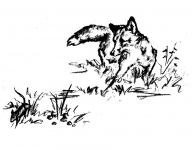
W.H. DeCourcy Wright suffered a fatal fall from his horse while foxhunting on February 3, 1951. The horse stepped in a groundhog hole, throwing his rider heavily and breaking his neck. For years after that, Wassie Ball, another larger-than-life personage from the distant mists of Elkridge Harford Hunt Club history, albeit from a slightly more recent era than Mr. Wright, would thrill local youngsters by showing them that exact groundhog hole and then poking around in the loose dirt and stones surrounding the hole to find tiny shards of glass, ostensibly from the deceased foxhunter’s spectacles.
For my part, other than having a vague knowledge that DeCourcy Wright was one of the defining personages from the glory days of our hunt club before and after The War, and having an exact knowledge of which groundhog hole brought about his demise, I knew little about him.
Little, that is, until his grand-daughter Ann McIntosh left in my mailbox the collection of his writings that comprise this book. It turns out that this is one of the freshest, brightest, most brilliant and original collection of “sporting” pieces I have ever read. By the way, “sporting” is intended to be descriptive, not limiting. This is wonderful writing, period.
It is very difficult to write well, for an adult audience anyway, of the thoughts and feelings of an animal. Tolstoy marvelously recounted a steeplechase through the eyes of one of the competing horses in Anna Karenina, as well as a bird hunt from the standpoint of one of the pointers in War and Peace. That’s been pretty much it, at least in my reading experience. DeCourcy Wright pulls off this impossible task with insight and charm in several of his pieces.
Some of his stories are about foxhunting, both here in the United States and in Ireland. There’s been quite a lot of very enjoyable foxhunting literature. The sport lays bare a multitude of human foibles and strengths, and the good writer can have a field day. DeCourcy does, and in his pages you may well tingle with anticipation as the adventure of a chase unfolds, gasp at the brave deeds of some participants, laugh aloud at the misadventures of others, nod sagely as the sport lays bare the character flaws of some and elevates others to heroic stature. Surtees’ writings are the jewel of this genre, but, to my mind, DeCourcy Wright is every bit as good and in some ways better, for, in the end, he finds and beautifully articulates a transcendence, a timeless and redeeming value in our sport, which I have never thought about. But I think he’s right. I bet you will, too.
To order this book, send a check for $33 made out to “EHHC” to Ann L. McIntosh, 3810 Beatty Rd., Monkton, MD 21111.
H. Turney McKnight is a foxhunter and was a successful amateur steeplechase rider.
A DeCourcy Wright Sampler
Of the fox:
“It is possible that he was not content with such a diet as nature provided for him, but chose to invade the domain of man, and to filch from an ill-protected roost of chickens, a matronly hen….Pleasure would be too mild a word to employ in describing the fox’s sensations resulting from a successful venture of this kind. Wild rapture would be more appropriate, with a dash of sneering derision and scornful mockery of humankind, whose efforts at poultry raising the wild animals find so interesting.”
Of the Master:
“The Master was especially serious today because of the presence of several old veterans from other hunts, who knew the game as well as, if not better than himself, and whose sharp eyes would see every move he made. After the fox should be afoot and the hunt be on, in that wild gallop that he hoped to provide for the delectation of all, he would be no better than anyone else, except insofar as his good horse and his knowledge of country and how to cross it might keep him on top.”
Of the Irish foot followers:
“After a long while, someone spied on a distant hillside what looked to be a horse down in a ditch. Several people were grouped about the object, whatever it might be. This afforded those on the bank a crumb of interest if not comfort. Also there suddenly appeared as if from nowhere, a red-coated figure leading a horse along a little byway, almost hidden by the gorse-grown banks that lined it. This offered food for speculation as to how and why one so soon had had enough of the sport. A little later, a loose horse, with reins and stirrups flapping, came down the same little byway in a trot. He too apparently had decided to hunt no more that day…. The group on the bank felt their interest revive. Grief and trouble had imparted flavor to the placid landscape lying peacefully before them.”
Of the foxhunter:
“Masefield told a good story of a hunt, but he gave the picture as it appeared to him, an outsider. The real experience consists not in all the extraneous incidents, landscape, and whatnot, but just the music in your heart as your horse puts footprints in the turf and distance and fences behind him.”
Of the Irish foxhunter:
“I succeeded in negotiating several of the dykes and was beginning to find the game interesting, though arduous, when a fair lady and her horse fell with a tremendous splash into the water. Friends rallied to her assistance, and the scene became one of great confusion, with loose horses running about, the lady and her friends screaming and squealing (not from fright for it takes much more than that to scare an Irish lady), but rather in amusement.”
Of stress:
“The fox was looking and listening for his pursuers, that was plain. No opportunity has ever come to me to observe a human being under like circumstances, but I fancy that his expression might be about the same. Happily it does not fall to our lot to be pursued by packs of hounds, but most of us have been pursued by packs of troubles, quite as hard to fend off, so I did not feel pity for the fox, so much as admiration for his cleverness and marvelous ability to run.”
December 30, 2010