
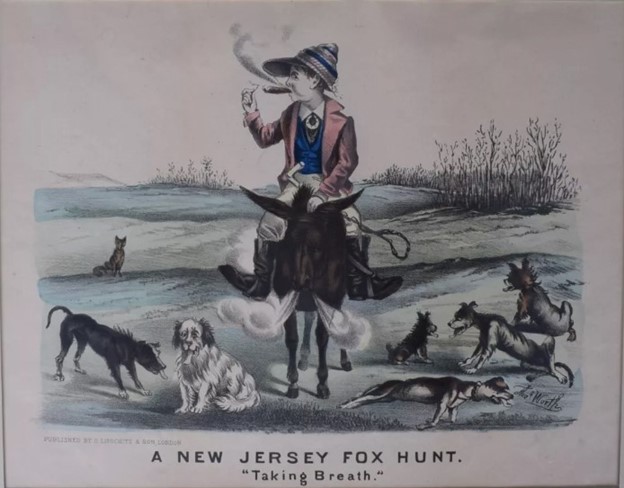
Thomas B. Worth American / Publisher Currier & Ives American
1876
In the center of this comical fox hunting scene, an exhausted donkey (facing the viewer) snorts breath from its mouth. A boy sits on the donkey’s back; he is dressed in a red jacket, too big black boots, and a too big, striped, visored cap. As he sits on his resting donkey, he puffs smoke from a big cigar, which he has just lit with a match held in his right hand. Sitting in the foreground are six panting, exhausted dogs: four are at the lower right (one of them is lying down), and two dogs are at the lower left. All of them have their tongues hanging out. In the left middleground, a pert fox sits and looks at the worn out hunters. Clumps of leafless bushes are in the background,
Nathaniel Currier, whose successful New York-based lithography firm began in 1835, produced thousands of prints in various sizes that together create a vivid panorama of mid-to-late nineteenth century American life and its history. People eagerly acquired such lithographs featuring picturesque scenery, rural and city views, ships, railroads, portraits, hunting and fishing scenes, domestic life and numerous other subjects, as an inexpensive way to decorate their homes or business establishments. As the firm expanded, Nathaniel included his younger brother Charles in the business. In 1857, James Merritt Ives (the firm’s accountant since 1852 and Charles’s brother-in-law) was made a business partner; subsequently renamed Currier & Ives, the firm continued until 1907.